Thursday, 30 July 2015

When Sahyadri Comes Alive…..!!

||Jay Shivaji||
||Jay Bhavani||
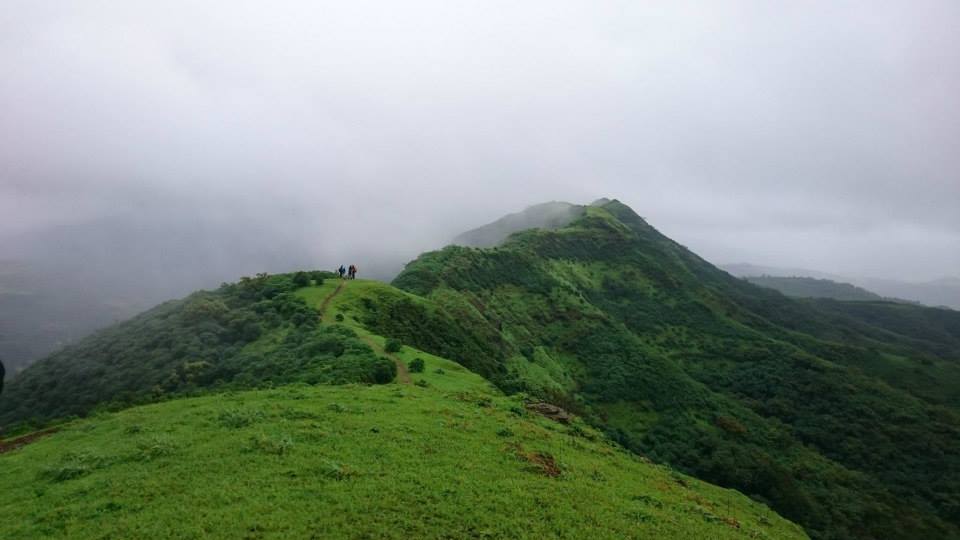
It is said that Sahyadri’s of Maharashtra are queer than Himalayan Ranges. When you are in Sahyadri one need to watch every step otherwise you may get lost and end up nowhere far from the place you are supposed to be. But that doesn’t take away the beauty of it. Ranges personify beauty in monsoon. They cover up with lush green trees and waterfalls falling at every turn. The Scenic beauty is picturesque, as if someone has painted it on canvas. Thus our journey began in these great Ranges of Sahyadri on the two Forts built by great King Chatrapati Shivaji Maharaj. These two forts actually began his journey of establishing Swaraj against Adilashi and Mughals. The two forts were very first to be captured by King Shivaji and his companions for life called Mavale.


Rjgad to Torna Trek Route
The Trek.

Ascend to Rajgad.

So Our Trek started from base village Gunjavane of Rajgad. We had a nice hot meal there, villagers provide the meal at reasonable rate. Trek from here takes you to Chor Darwaja of Rajgad. This route is little difficult as there are steep patches in between, but if you are up for adventure then go for it.
As we started climbing we were already in dense forest. Trees were all along aside us and nothing else. Wherever we looked we had a sense of wonder. As we climbed up, we were surrounded by dense fog, fog that sometimes even makes person in front of you invisible. Somewhere as we were climbing the fog cleared and it was surprising to realize how much height we have covered. From there the huts in villages looked like tiny pieces, and the water that is flowing like a line.
There are railings constructed at some very steep rocks, so it helps you to climb. The spot of railings tells that you are closer to fort. A little further, or say a little higher and the Chor Darwaja came into sight. It is built exactly as it says, very small in height, we had to duck to enter it. The purpose of it was to escape if enemy attacks on the fort. Also one other purpose was; the informers of King used to come through this door. Thus we entered the fort and as we walked into it a beautiful lake built by King Shivaji came into view ‘Padmavati Lake’. The lake is always filled with fresh water and is never dried out. It is well constructed and has rectangular shape also it has steps to descend and fetch water. It is advised not to jump into lake as it is deep also water is very cold.
Stay at Rajgad.

There was dense fog on the fort. As we crossed the lake we came across few stonewall rooms which were built in those days. They might be living rooms or storage rooms, purpose is not known. There is temple of ‘Padmavati Devi’ in front of these stonewall rooms. 
The temple was also built by Shivaji Maharaj. Straight in front of temple is Saibai, Shivaji’s first and most beloved wife’s Samadhi. We had started around 3 pm and reached the fort around 6 pm. It was heavily raining. The temple can accommodate around 60 people, also the rooms built in temple can accommodate people for staying overnight but they leak and are not maintained properly in rainy season. We stayed in temple for the night. It was tempting to go outside for a walk on the fort as it is so greatly built but because of dense fog and heavy raining the group that led us advised us to stay in temple only. Although we had fun in temple, we did aarti in the evening at around 7 pm, shared ghost stories which really scared hell out of some people :P, some also had deep conversation about King Shivaji and his times, it is hard not speak about him when you are trekking on his fort and staying there. There are some beautiful paintings hanged on the wooden columns of temple and Marathi shlokas about King Shivaji and his first son Sambhaji are written on it. Again the villagers provided us diner, and after that we immediately slept as next day a long trek was to be done.  So we slept in biting cold, at least I did; forgot to pack my shawl. Next day we got up at 5 in the morning had hot tea, warm breakfast and packed up to enjoy best part of the trek. There is a Well besides temple with fresh water in it, we filled our water bottles from there. Wow imagine the resources that were planned in those days..! 


Rajgad to Torna.

So now comes the most exciting part of the trek Rajgad to Torna….!! In morning around 6 we started onwards Torna. Whilst walking we got to watch remains of Sanjeevani Maachi, and from that door you exit Rajgad.
This trek is full of adventures, there’s rock climbing, descending, steep slopes, zigzag ways, narrow pathways and sometimes you slip on muddy earth Oops..!!. It became difficult as we moved forward, but we had great organizers with us; guiding all the way through. As we started descending Rajgad there are remains of big rock walls guarding the Fort. As we descended further there were steep rock patches and the view in front was awesome. You are in midst of Sahyadri ranges with mountains on every side, waterfalls falling from them some from very high altitude. After descending Rajgad you come across a tar road that separates two mountain ranges on which forts are built. Now we started ascending for Torna, but to reach Torna we had to cross 15 to 20 hills till we reached Torna,
there was ascension and descension, again and again. While trekking here we saw endless variety of plants and trees, on some of which flowers were blossoming, some having thorns, some plants had so strong branches that we used to hold them and climb. We came across few straight ridges on some of the hills, the wind on these ridges blew our minds, and the rains slammed us across, because you are not walking under the clouds, but besides them, right through them.
After sometime the fog cleared and we felt as if nature had come alive Sahyadris have come alive, a breath taking beauty that leaves you speechless. We felt as if nature was in conversation with us, telling us tales of its existence over the years and inviting us to experience it. The Sahyadris you realize are not mountain ranges that throw you off the cliff, but are built as if to guide you and take you in its arms to give you sense of wonder. While looking at its great beauty I realized how much time I have spent worrying about unnecessary things and how much can be achieved in life without such qualms and how much nature is left to be explored and understood.
We were tired after such long trek but this ridge boosted our energy and the further hills were calling us to complete our journey, to explore them and give them a chance to show their wonders. And so we continued. Every hill showed us vast amount of nature and gave a spectacular view of Sahyadri Ranges.


Ascend to Torna.
Finally the watch tower (Buruj) of Torna came into sight, the surface is flat at the base of watch tower.
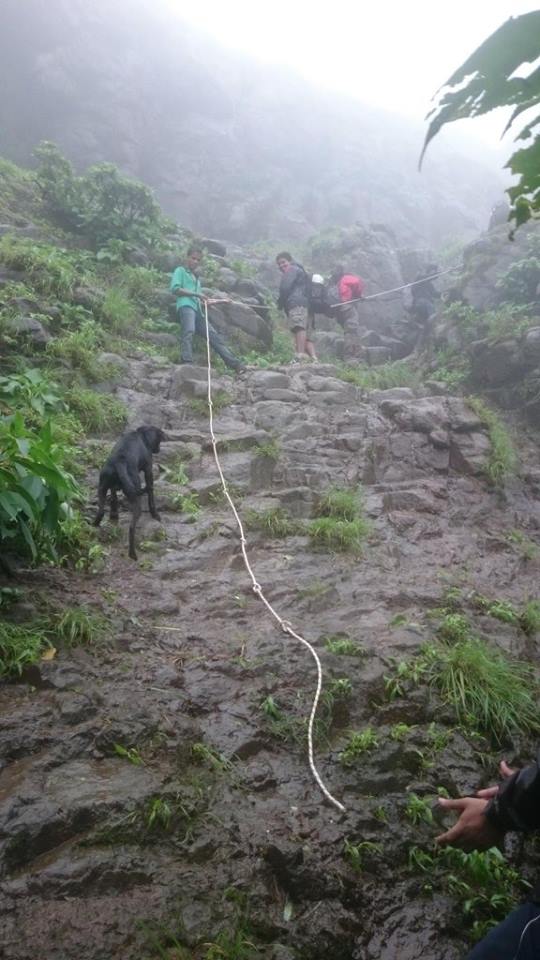
We thought adventure was over, but it wasn't; now came the real thrilling part of our trek. The rope that our organizer were carrying was to be utilised and that time had come.  We walked further the tower and there comes one rock patch which need to be climbed.

Actually it can be climbed without rope if you are a good trekker but our organizers did not wanted to take any chances. So the rope was put and one by one we climbed it. As we climbed the rope we had to further climb the rocks and at one point we were standing literally on a point. This exercise was done one at a time, and up ahead we stood on another watch tower. But the trek was still not over yet. We passed the lush green fields of plants planted on the mountain, walked further and arrived at yet another rock patch. Again with use of rope we climbed and stood on a very narrow ridge. As we were standing the view from up was unimaginable, the river was flowing; cutting across the ranges at the base and going into the villages. It looked exactly like we drew the picture of mountain and river as school kids.  Finally Darwaja of Fort came into view from the misty fogs. Entering it we walked further to reach the temple of Torna Devi. We had started at 6 in the morning and reached Torna at 5.30 in the evening.

Descend from Torna.
We had our meal in the temple again provided by villager’s who carry it up to the fort. Torna is the highest fort in Pune region and in 2nd highest in Maharashtra, it was chilling outside also the rains were slashing hard. Immediately we started descending as we had to reach before getting dark. While descending we came across water tanks, built from those days filled our bottles and started climbing down. There were railings constructed on rock patches, it becomes easy to descend. After the rock patch descend is quite easy mostly walking down. But there are 2 crossroads where, one could take wrong route and end up somewhere else. Same thing happened with us at the last crossroad me and my friend actually went on right route, as we had seen on of the group leaders going from there. But few people took the other route ended on a constructed cement road, they thought as they have reached road they are right so they signalled us with torch as it was already becoming dark. We then again went back. It was a confusing situation. But the group leaders in the back arrived and then it was decided that some will take cement route and some will follow other as both routes intersect further at the base village. Finally we reached the base village Velhe. It was end to a lifetime experience….!

We were 37 of us lead by 5 people of organizers and it was amazing effort put by every one of us to make this trek a wonderful and adventurous experience. In the group two girls were first time trekkers and the trek is actually not recommended for first time trekkers. But with the amazing encouragement shown by everyone and especially by the organizers they were moving forward; also the climate and the all around beauty of mountains inspired them to carry on and  accomplished the trek successfully. At the end they were happy about coming to the trek and experiencing it with all of us. Truly if one can accomplish such a difficult trek in first go; it would feel easy to expedite on other such treks.


Organizers – Small Steps
The group of 'Small Steps' consisting of five individuals(Sagar, Yogendra, Prashant, Ravi and Sushant) are like five fingers of hand, palm when closed becomes fist leaving no gap in between, beholding the trekkers with them all the time. One leads in front, one at the very back and three in between, interchanging their positions as and when required. They guide on every step and are not some sort of high handed experts that pretend to know everything; but interact with you as friends and make the experience of trek most enjoyable. Also they boost your confidence and encourage you. In my various treks with them; they have befriended me and now consider me as their part. They constantly take feedback from the trekkers to improve upon if anything needs to be. At the end you feel; you have enjoyed, got thrilled, had an adventure and finally had a sense of accomplishment. 

Technical details of Trek:

Cost of trek with Small Steps: 1800 per person (included bus from Panvel to Rajgad and back to Panvel from Torna, 3  meals of both the time and 1 breakfast)

Rajgad: 1318 meters above sea level (4250 feet)


Torna:   1405 meters above sea level (4600 feet)

Gunjavane Village (base village at Rajgad): 60 km from Pune.

Velhe Village (base village at Torna): 45 km from Pune.


Rajgad to Torna Stretch: Approximately 12 km.


Thursday, 25 December 2014

Bharat Ratna Atal Bihari Vajpayee – A Leader who transformed India.


 25th December 2014 marks the 90th  birthday of  India’s one of the most respected and admired leader, Shree Atal Bihari Vajpayee.   

Albeit he has been aloof for a while from Indian Politics now, His is the face that one will never forget. In a list of people that inspires every generation Atalji’s name will be the prominent one. He was an astute politician, a pan-India leader after Indira Gandhi, a poet whose words touched the heart and mind subtly, and a magnificent orator who would charm even his political opponents.
Such was his oratory skills and such was his debating capabilities that even our first Prime Minister Pandit Jawaharlal Nehru once said that “this young man will one day become the PM of India”, and he did,
not once but three times until his party received the full fair opportunity to govern the country for 5 years.
He was an exuberant speaker who would entice everyone into his thoughts. He was a connoisseur of diverse and multi-party parliamentarian system of India. He was a persevering figure with an efficacy for his decision but also he never looked despondent after failure.

Shree Atal Bihari Vajpayee was a Member of Parliament for almost 50 years without even tiniest of stain on his political life and remains so.

He began his career as a journalist; .He entered into Politics drawing inspiration from Dr. Shyama Prasad Mukherjee. He belonged to RSS(Rashtriya Swayamsevak Sangh) from early years of his life. After spending 40 years in active politics and being the member of parliament, he became the Prime Minister of India in 1996, unfortunately just for 13 days, but it was like the fate had decided for him to be  the Prime Minister, so again he ascended on PM’s chair in 1998 and lastly in 1999 till 2004.

But in those 6 years of his government though India faced many troubles, many problems nationally, internationally with a visionary like him the country progressed as such never before. Belonging to the party which has a perceptive Right Wing face, he always underwent scrutiny from his political opponents although he was well respected across the party lines. 

He also shared friendship with many leaders belonging to different political parties.Prime Minister Narasimha Rao sent him as a Head of the Delegation to the Human Rights Commission Meeting at Geneva in 1993, even though he was a leader of opposition then. In his life he was part of many parliamentary delegations right from the start, first being in 1965. He also became Foreign Minister during Janata Party government from 1977 to 1979 after Emergency. He was the first person to deliver a speech to the United Nations General Assembly in Hindi for which he was acknowledged and widely appreciated. 
His achievements as a Prime Minister have no other match. Within just a month of taking up the office,India conducted a nuclear test for which he received applaud within the country but was criticized internationally especially by U.S.A and Japan. But this did not stop him, he very well took care of foreign affairs, and explained India’s position about becoming a nuclear state which had purpose of having a credible deterrent for its defense .On economic front he continued the economic liberalization initiated by his predecessor P.V Narasimha Rao, and then Finance Minister Dr. Manmohan Singh. He enhanced it, gave it new directions and India witnessed highest economic growth during his tenure. He made India Food grain exporter, a major-outsourcing country and enriched the country with over billion dollar foreign exchange reserves. Infrastructure development was the cornerstone of his governance. The Golden Quadrilateral and Pradhan Mantri Gram Sadak Yojna are the two pillars of it. Even after criticism of Nuclear Test he extended his hand to foreign nations to improve relations and how India could contribute to development of the world. He also made his stand clear about India always being on the side of Peace. The improvement in foreign relation is very much evident by the fact that after 22 years the then President of United States Mr. Bill Clinton visited India. Also a fact needs to be taken note of Shree Atal Bihari Vajpayee was the only foreign  P. M  to address the constituent assembly of United States in  September 2000. India also established a great strategic and military relations with Israel, continues to do so. Tibet was recognized as a part of China and China recognized Sikkim as a part of India during his tenure. Many educational reforms were also put in place, Sarv Shikshan Abhiyan was launched by him.He took under many expeditions, such as Chandrayan programme, linking rivers to solve irrigation problems, speedy communication system and establishing 'Sagar Mala' to connect 4000 kms of coastline.
During his tenure country also went through few predicaments. The first one being Kargil War, well everybody knows the history about it. The Strong Military of India stood up to the task and India defeated Pakistan in Kargil. The Hi-jack of a Plane, infamous Kandahar episode, once again with strong leadership India emerged out of it. The Parliament attack that terrified the country. But the stand of our leader was clear and it was Peace. The Gujarat Riots, in 2001 is one dark spot, at this point he wanted to resign, but later was convinced by his colleagues not to. After the Kargil India never tried to aggravate itself towards its adversaries. Rather Shree Atal Bihari Vajpayee was the P.M who initiated peace talks with our neighbors, whenever and wherever he saw the scope for it.He was a firm decision maker.
But in 2004 even after so much progress the verdict of people was not in his party’s favor. But he was never disheartened by it; he accepted the defeat with full responsibility and in 2005 because of health constraints resigned from active politics.
The fact remains that during the period of Shree Atal Bihari Vajpayee’s governance India uplifted itself in development process. He is the leader who in every sense transformed India.
A Statesman par excellence, a Visionary, a person with utmost integrity, an extraordinary orator and a poet from heart. Vajpayee describes his poetry in his words “My poetry is a declaration of war, not an exordium to defeat. It is not a defeated soldier’s drumbeat of despair, but a warrior’s will to win. It is not a dispirited voice of dejection but the steering shout of Victory." 
I congratulate him on his birthday for receiving country's highest civilian award. A true 'gem' has received 'Bharat Ratna'
Atal Bihari Vajpayee will remain an inspiring figure for present and many generation to come.


Please See : Information given above is adopted from various sources and books.


Sunday, 27 April 2014

Curiosity


"The first and simplest emotion which we discover in human mind is curiosity" – Edmund Burke. Indeed How true…!! , right through the Ages people have tried to define life, but something which always has been the aspect of definition is curiosity, the reason behind defining life itself is curiosity about it.
Ironically Curiosity is one distinctive character which every person shares, how far we exercise it, is a matter of personal concern, but something that drives us is curiosity. Every emotion that humans are capable of expressing has an underlying part of curiosity attached to it. Every great person that has lived on this earth has quoted importance of curiosity in our lives. Right from the childhood to an old age, in whatever direction we move largely depends on this quality of curiousness. In the 21st  century technology oriented world this aspect, quality or emotion has become more and more discernible. The discoveries the innovations the inventions are nothing but outcomes of curious minds.
I really feel that even the scientists are more driven by curiosity than science itself. Curiosity develops interest, interest develops choices, and the choices that we make, makes us. If we really want to lead a driven life, a passionate life than we have to be curious. Everything in the world is driven by this great natural, innate sense or force. The world revolves around this, and there would be hardly any person that disagrees with it.
Imagine what world would be like without it, it would be like a body without a soul, a mind without thoughts, and life without goal. Something that each and every one of us must always nurture is curiosity, I wonder how one would live without it. As Albert Einstein once said "Never lose the Holy Curiosity".
So Be Curious.

Friday, 13 December 2013

Acting by Choice


Sitting across the table, gazing out of the window, with a coffee mug in my hand sometimes I feel I am thinking something deep, philosophical. How my life is taking turns, how it has come to this, failures, success, happy moments, sad moments, terrible, terrifying, well and many more verbs and adjectives. But at the end I realize all I do is measuring my life in terms of adjectives that do not mean anything in far above of everything where there is just eternity and nothing else. Why do we do that, why do we try to measure everything that happens to us, why can’t we just live as life goes  day by day, hour by hour, minute by minute and second by second. As said in Bhagwad Geeta by Lord Krishna just do your Work, just Act Right, and don’t think of whether you will succeed or fail. Well at the end of the trail of thoughts I feel stupid, I feel idiot to have thought all those things, because life does not change JUST by thinking, It changes when you act, when you make decisions.

But again one can’t stop thinking; one must not stop thinking because sometimes that is what makes us sane person. I always remember this one little thing; I travel by local trains in Mumbai extensively. I travel to my office daily, while returning I always find few poor children begging in that particular boogie, always the same ones. It’s true if you’re a regular traveler in Mumbai locals on any one route you may often find same poor people begging every day, it’s a fact! So coming back these small little children beg every day and I watch them, observe them, frankly speaking I sometimes give them money and sometimes I  don’t. But they move me. There’s a twinge of pain I feel every time when I see them. I just can’t imagine how they live, with few coins everyday what do they eat, what goals they can have. What ambitions they can achieve. What possibly is there life!!!! For some people it may be mundane thing but for me every day it is a painful experience.
Now when I juxtapose my situation and this situation , how do I even have a right to have those hypocritical fancy philosophical thoughts of measuring life’s parameter when there are people in this world who don’t even have privilege of sitting and thinking,  who have to beg for their food, who have to beg  for  shelter. Then I think we have been delinquent in upbringing such struggling people as a society. Sometimes I just can’t get acquiesce to the idea that I have to live my life and certain underprivileged class of people will have to live there’s. We as a society or I as a person hopes that someday there will be a balance in society   or such class of people will surely get help. But then sometimes HOPE is just amother fancy word.
Unless we inculcate on minds of one another that unless we stand up and help, that unless we as a society make decision that something needs to be done, I feel nothing will change. There has to be some conscious effort from us rather than just blaming the governance and government for it. Envisaging that “everything will be fine” picture at the end does not change present day's fact. I feel that is the essence of ACTION as above mentioned lesson from Bhagwad Geeta. Yes you don’t worry about results, don’t expect them but it is our choice what work we do, what actions we take, decisions we make.

With this trail of memory I go back to the work I was doing. You know as they say in French c’est la vie, and life goes on. But I believe someday we have to change, we must; at least I will, by making right decision; right choice.

Young Indian